
The Day the Sonar Spoke
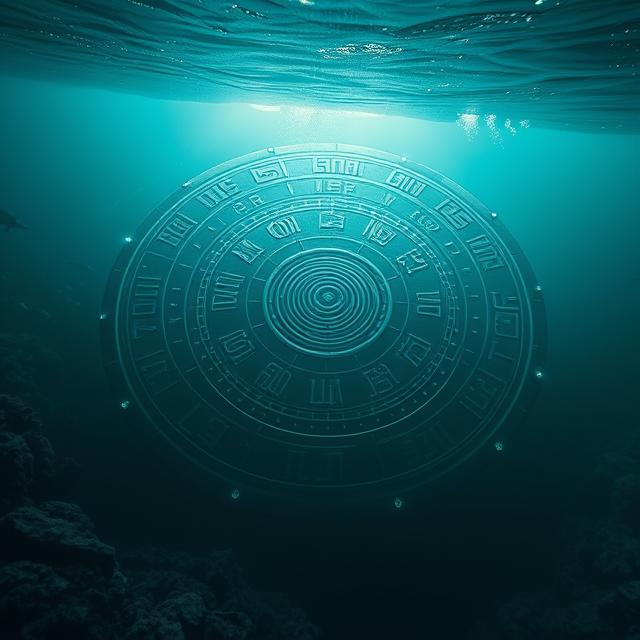
In June 2011, Swedish deep-sea explorers Peter Lindberg and Dennis Åsberg were searching for a centuries-old shipwreck when they stumbled upon something far more enigmatic. At a depth of around 90 meters, their sonar scanner picked up the image of a massive circular object—about 60 meters in diameter—resting on the Baltic Sea floor. The formation appeared too symmetrical, too deliberate to be a natural rock.
They named it the Baltic Sea Anomaly, and what followed next was a decade-long dive into the unknown.
Anomaly or Artifact?
The sonar image resembled a perfect disc, with rounded edges and odd right angles that resembled ramps, stairways, and corridors. One feature seemed to be a dome-like structure. Beneath the disc, a raised “pillar” suggested that the object could be perched on something, or perhaps partially buried. The seabed trail behind the object stretched over 300 meters, implying the possibility that the structure had skidded into place.
Peter Lindberg initially assumed it was a geological formation. But as their dives progressed, even the seasoned crew began to question that assumption.
“We’ve never seen anything like this,” said Lindberg during a press briefing. “The shape is extraordinary, and the features are too regular to be ignored.”
Equipment Disturbances and the Silence of Science
When the Ocean X divers descended to the anomaly, they reported strange malfunctions. Cameras and sonar stopped working. Satellite phones failed. Even their compasses spun erratically.
Such electromagnetic disturbances are not normal—especially in a region devoid of known magnetic anomalies. Some speculate this is residual energy from ancient technology, or perhaps a signature of an extraterrestrial crash site.
Despite collecting physical samples, analysis yielded no clear answers. Geologists initially claimed the object was composed of granites, basalts, and gneiss—common to the area. Yet, some experts questioned how volcanic rocks (like basalt) ended up in a region with no current volcanic activity.
Was it Man-Made—or Non-Human?
Over the years, theories have emerged:
- Alien Spacecraft: Due to its resemblance to the Millennium Falcon and electronic interference, many believe it’s a UFO—specifically, a USO (Unidentified Submerged Object).
- Ancient Megalithic Structure: Some argue it could be a remnant of a pre-Ice Age civilization lost beneath rising seas.
- Geological Formation: Skeptics say it’s a glacial deposit—formed naturally during the last Ice Age.
- Nazi Anti-Submarine Base: A few researchers claim it may be a secret WWII relic, abandoned in a hurry.
However, none of these theories fully explain the object’s geometry, the surrounding seafloor patterns, or the electromagnetic disturbances.
A Curtain of Silence
Despite the worldwide attention, further scientific investigation has been limited. Many experts refused to back the Ocean X team, citing lack of funding or “interest.” Others quietly distanced themselves from the subject altogether.
Dennis Åsberg stated in an interview:
“It felt like something—or someone—was trying to stop us. When our instruments failed underwater, it wasn’t just coincidence.”
To this day, no official scientific expedition has been sanctioned to study the anomaly in depth. Some suggest it’s due to geopolitical tensions in the region; others suspect a deliberate cover-up.
Could It Be a Beacon?
Some theorists believe the anomaly is not a crash site—but a beacon. The object’s perfect alignment with ancient trade routes and ley lines has led to speculation about Earth’s geomagnetic grid, similar to theories about pyramids and Stonehenge.
There are even whispers that a signal may have been detected from the object—low-frequency vibrations that some claim to have heard during dives, akin to a hum, a pulse, or even a voice.
A New Atlantis Underwater?
The Baltic Sea Anomaly challenges our understanding of Earth’s past and its hidden architecture. Is it the remnant of an antediluvian civilization wiped out by cataclysm? Is it a vessel from another world? Or is it a warning buried in plain sight?
Until the veil of scientific silence is lifted and a multidisciplinary team investigates this object thoroughly, the anomaly will continue to provoke, inspire, and mystify.

