
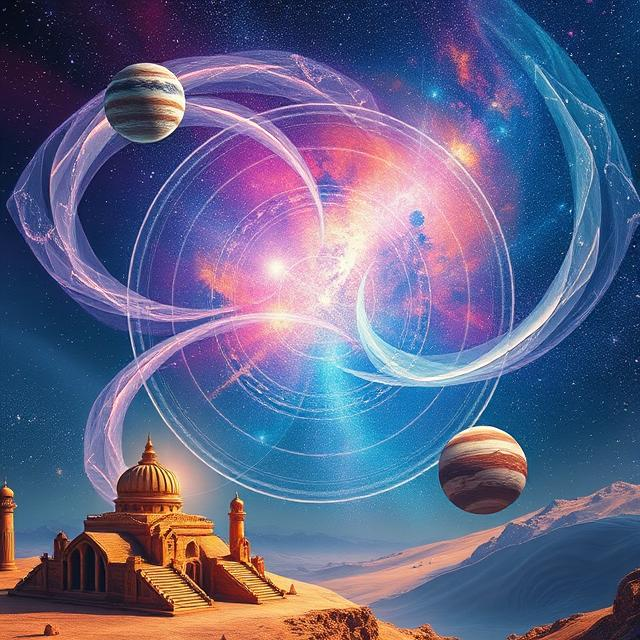
The Hidden Geometry of Music and Sound
Music and geometry share a deep and ancient relationship. Across cultures and centuries, scholars and mystics have recognized that sound is not just an auditory experience but also a phenomenon governed by mathematical principles. Harmonic frequencies follow patterns found in nature, architecture, and even the cosmos. This suggests that music may be a fundamental key to understanding the universe itself.
The Mathematical Nature of Sound Waves
Sound is vibration. Every vibration can be represented as a waveform—a repeating oscillation moving through space and time. When we analyze these waves, we find that frequencies that create harmonious sounds follow strict numerical relationships. This is where music and geometry come together.
Pythagoras, the ancient Greek philosopher, was one of the first to formalize the mathematical laws behind musical harmony. He discovered that musical intervals (such as the octave, fifth, and fourth) correspond to simple whole-number ratios. These ratios mirror the geometric patterns found in nature. This reinforces the idea that sound and shape are deeply intertwined.
The Octave: A Reflection of Cosmic Cycles
The octave is the most fundamental interval in music. It has a frequency ratio of 2:1. This means that when you double the frequency of a note, you hear the same note at a higher pitch. This simple yet powerful relationship can be visualized geometrically as a circle. One complete revolution of a circle brings you back to the starting point. This cyclic nature mirrors the movement of celestial bodies, planetary orbits, and the continuous flow of time.
In stringed instruments, when you halve the length of a vibrating string, it produces a note one octave higher. This principle of doubling is reminiscent of fractal geometry. In fractals, self-similar structures repeat at different scales. We see this phenomenon in nature, from spiral galaxies to snowflakes.
The Perfect Fifth: The Golden Ratio and Harmonic Symmetry
The perfect fifth (frequency ratio of 3:2) is one of the most stable and pleasing musical intervals. It forms the foundation of Western musical tuning and has been revered for its harmonic balance. Interestingly, this interval closely aligns with the golden ratio (ϕ ≈ 1.618). This proportion appears in art, nature, and architecture.
In geometry, the pentagram (a five-pointed star) contains golden ratio proportions. This shape also frequently appears in musical harmonics. From the spirals of seashells to the proportions of the human body, the golden ratio represents an intrinsic harmony in the fabric of reality—one that music also follows.
The Perfect Fourth: Stability in Square Geometry
The perfect fourth (4:3 ratio) has been linked to the square. The square represents stability, balance, and structure. The Pythagorean tuning system relied on fourths and fifths to construct musical scales. This reinforces the idea that these intervals serve as fundamental building blocks of harmony.
In architecture, sacred sites like the Great Pyramid of Giza and ancient Greek temples incorporate these mathematical relationships. Such structures were designed not only for physical stability but also to enhance spiritual and acoustic experiences.
Harmonic Lattices and Higher Dimensions
If we extend musical intervals into higher dimensions, we encounter the concept of harmonic lattices. These lattices visually map how musical notes relate to each other in geometric space. They resemble crystalline grids in three-dimensional structures.
One such model is the Tonnetz, a hexagonal representation of musical intervals. This model allows us to trace harmonic motion as a spatial journey. Similar representations exist in physics, where crystal structures and atomic arrangements follow geometric patterns. These patterns resemble musical tuning systems.
The Cosmic Dance of Frequency and Form
Modern research in cymatics (the study of visible sound vibrations) provides further evidence of the connection between sound and geometry. When sound frequencies pass through a medium like water or sand, they create intricate geometric patterns. Different frequencies produce distinct shapes, often resembling mandalas, snowflakes, or sacred symbols from various spiritual traditions.
This suggests that music and sound may be fundamental forces shaping the physical world. Some mystics and quantum theorists propose that reality itself is built upon vibrational structures. The universe functions as an intricate symphony of harmonic frequencies.
The Spiritual and Mystical Implications of Music Geometry
Throughout history, cultures have recognized the sacred power of music. From Sufi whirling dervishes reaching trance states through rhythmic movement to Tibetan singing bowls used for meditation and healing, music has long been viewed as a tool for spiritual elevation.
Ancient civilizations like the Egyptians, Greeks, and Hindus believed that musical scales corresponded to cosmic order. They believed music influenced human consciousness and even altered reality. Today, modern sound healing practices use frequencies such as 432 Hz and 528 Hz. These frequencies are believed to promote healing and inner harmony.
The Universe as a Symphony
Music and geometry are not merely artistic or scientific constructs. They are fundamental expressions of the universe’s underlying order. The octaves, fifths, and harmonic lattices that define our perception of sound also shape the cosmos. Whether through the spirals of galaxies, the symmetry of atomic structures, or the vibrations of sacred chants, the same mathematical truths repeat across the universe.
By understanding music geometry, we gain insights into not only the mechanics of sound but also the very fabric of reality. Could it be that the universe itself is a grand symphony, vibrating across dimensions that are yet to be fully understood?

